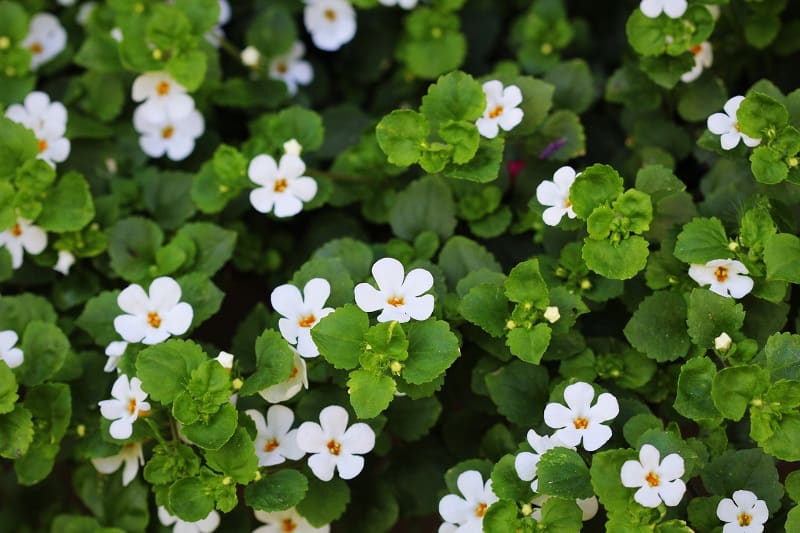
Bacopa, scientific name Bacopa monnieri of the genus Sutera, is famous for its pure white, blue or pink flowers. These perennial creeping herbs are native to the wetlands of Europe, Africa, Asia, North and South America, and Southern and Eastern India. They are also referred to as water hyssop, brahmi, herb of grace, Indian pennywort and thyme-leaved gratiola. They are widely known for their medicinal benefits but, like most plants, they also have their share of problems that cause yellowing leaves.
Bacopa Leaves Turning Yellow: What Are The Reasons?
Iron deficiency or lime-induced chlorosis
Perennials like bacopa commonly develop lime-induced chlorosis, which results in the loss of the normal green color of the leaves. This usually happens because the soil pH has become too high for the plants to absorb iron. If not addressed promptly, the leaves will turn yellow while the veins stay darker green, and some plants may lose foliage and eventually die.
To fix the problem, fertilize with chelated iron. Ideally, you will see improvement within a few weeks, and the foliage will start to become green again while new growth will also appear. Learn to identify nutrient-deficient plants before it becomes a problem and feed them with fertilizers, especially if they are kept in containers or planters.
Downy mildew
Bacopa leaves could turn yellow due to downy mildew. This is an obligate parasite found in plants, and refers to any of several types of oomycete microbes. The spores on the undersides of the leaves spread to other plants via splashing water and air currents, and the spread is accelerated by moist conditions and cool weather. Aside from yellowing, some leaves will also curl downward and you may notice milky white spores on the undersides of the leaves.
To fix the issue, make sure to purchase only healthy plants from reputable garden centers and nurseries. Use new soil and sanitized containers, and if you find downy mildew on any of your plants, remove and discard the affected ones, including the soil and debris. Keep an eye on your plants and learn to distinguish downy mildew from other plant problems.
Insects and pests
Yellowing leaves could also be due to insects and pests like aphids and spider mites. Aphids colonize and feed on plant juices, eventually weakening the plants. Leaves become distorted and curled, and yellow spots will start to appear. Similarly, spider mites suck on plant juices and damage the leaves and other plant parts.
To exterminate these pests, you can use pesticides and insecticides or opt for natural solutions like ladybird beetles. Insecticidal soaps may also be used, but may not produce immediate results compared with chemical products or pesticides. Early identification is important so that proper and immediate action can be taken to avoid severe infestations.
Bacopa Plant Care
Bacopa plants are versatile perennials and vigorous ground covers, and are usually placed in window boxes, containers and hanging baskets. These plants quickly become covered with buds and blooms at the onset of warm weather. They should be fed regularly to keep up with their rapid growth. Stunted growth and yellowing foliage are often signs that your plants are deficient in nutrients and it may take weeks before they recover.
These plants should be kept moist with a steady watering schedule. They will stop blooming if they are not watered, even for just a day or two. Once they are watered sufficiently they will start to set buds, but it could take two to three weeks before they start blooming again.
Bacopa plants thrive in full sun to partial shade. If you are in a hot area, it is ideal to grow the plants with afternoon shade. There are certain varieties that you can experiment with if you want to cultivate these plants. Cabana is a compact, white-flowering variety, while Olympic Gold features white flowers with variegated leaves of gold and green. Other varieties include Giant Snowflake and Snow Storm Blue.
Conclusion
Bacopa plants are popular for their dainty blue, white or pink flowers. These perennial creeping herbs have medicinal benefits, but also have their share of disorders that cause yellowing leaves. This could be due to iron deficiency, pests such as aphids or spider mites, or diseases like downy mildew.
Image: istockphoto.com / Vaivirga